

Towit provides enclosed and open vehicle transport across the UK. We use Brian James trailers and work with private owners, dealers, and the motor trade.
A supercar spends most of its life being protected: garaged, covered, detailed, insured to the last decimal. Then, a few times a year, it has to travel, and suddenly the whole protection strategy depends on a trailer, a strap, and the person operating them. This guide explains how supercar transport works in the UK when it is done properly, what separates specialist equipment from a recovery truck with ambitions, and how to make sure the car arrives exactly as it left.
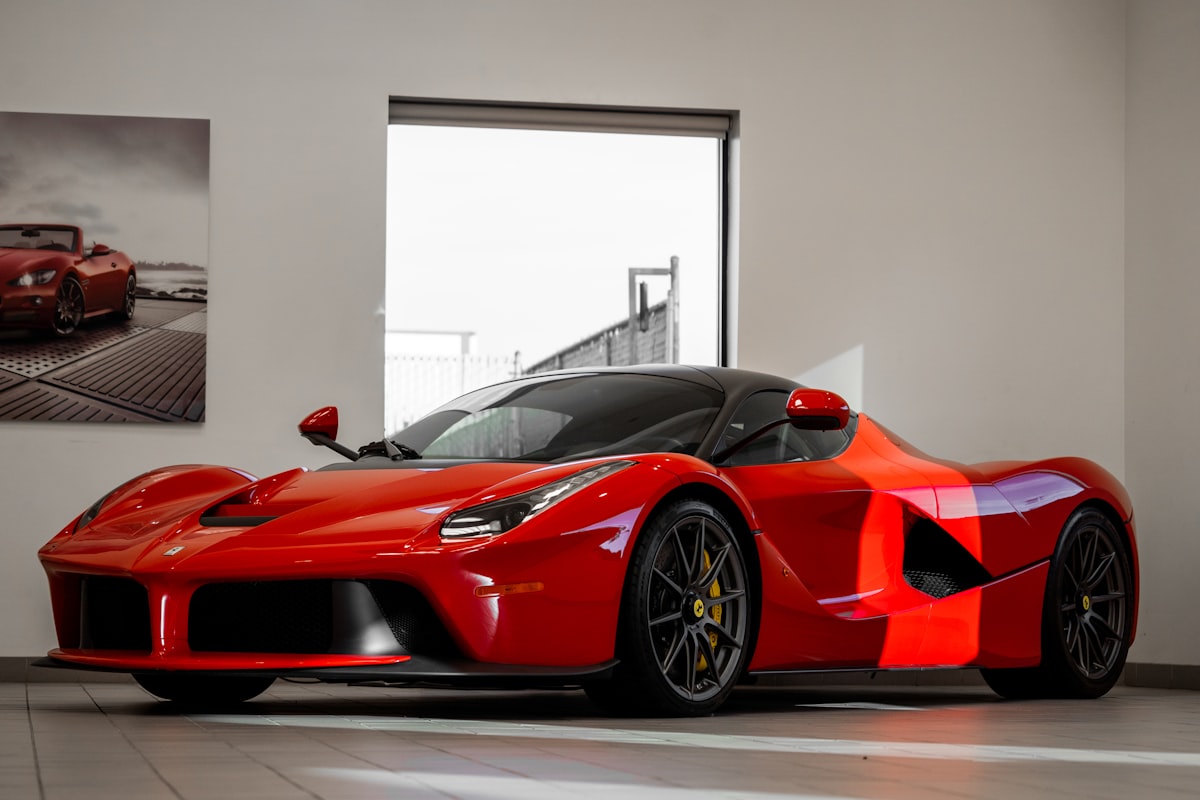
Three attributes make a supercar incompatible with general vehicle transport. The first is geometry: front splitters a few centimetres from the ground, long carbon overhangs, wide bodywork, and approach angles designed for aerodynamic performance rather than trailer ramps. Standard loading equipment grounds these cars; it is not a matter of care, it is a matter of angle.
The second is materials. Carbon fibre, forged wheels, ceramic brakes, and adaptive suspension respond badly to the traditional tools of vehicle recovery: chains, chassis hooks, and ratchet straps through the wheels. Securing a supercar means holding it by its tyres with soft straps, so that no clamping force, no metal, and no tension ever reaches the parts that cost five figures to replace.
The third is attention. A supercar on an open trailer is a spectacle, photographed at every junction and noticed at every services. Sometimes that is harmless. Sometimes, for a recognisable car heading to a known address, it is a genuine security problem. Enclosed transport removes the audience entirely.
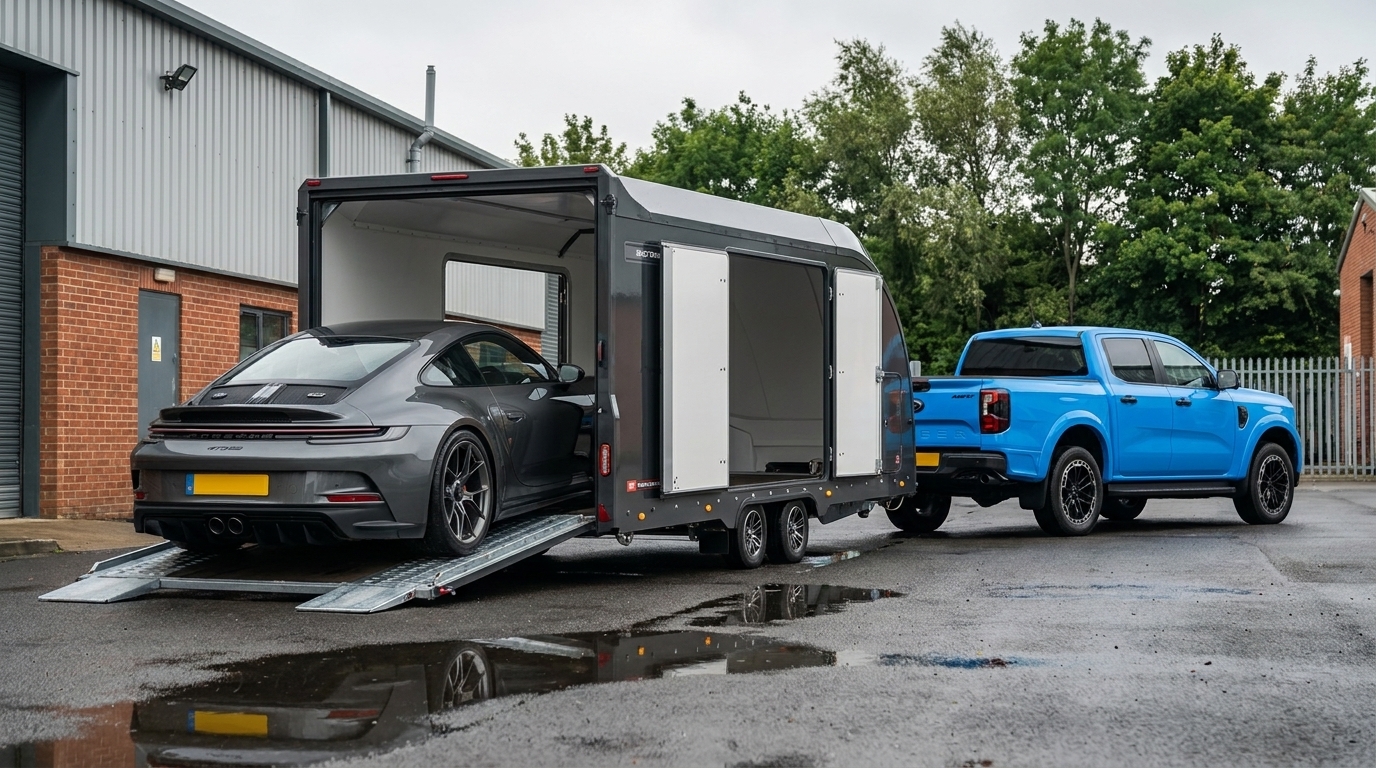
At Towit, supercars travel in the Brian James Race Transporter 7, and its three defining features map exactly onto the three problems above. The powered tilt bed lowers the loading angle until fixed splitters and flat floors clear comfortably; the car is driven or winched on at a gradient it was designed to handle. Soft over-wheel straps secure the car by its tyres, leaving suspension free to settle naturally and bodywork untouched. And the fully enclosed body isolates the car from weather, road debris, salt, and sight for the entire journey.
The tow vehicle matters too. A professional combination, in our case Ford MS-RT vehicles paired with the Brian James trailers, is stable, presentable, and driven by people who move valuable cars for a living rather than as a sideline. You can see the full setup on our fleet page.
Every movement is bracketed by a photographic condition report: all corners, interior, and any existing marks, documented at collection and confirmed at delivery. On a car where a single panel repair is a five-figure event, that documentation is not bureaucracy; it is the mechanism that makes the whole transaction trustworthy.
It is worth being specific about the failure modes, because they are predictable. Splitter and chin damage during loading is the classic: a car pushed up standard ramps until carbon meets steel. Strap damage is next: ratchets through forged wheels, hooks on suspension arms, or straps tensioned over bodywork, all of which leave marks that a condition report from a careless operator conveniently never captured. Then there is environmental damage on open equipment: stone chips in fresh paint, brake dust and grime baked across a detailed car, salt in every crevice in winter.
The subtler failure is informational. A car moved without proper documentation, by a subcontractor found on a bidding site an hour before collection, leaves the owner with no evidence, no accountability, and no realistic recourse when something is wrong at delivery. The cheap quote is cheap precisely because these safeguards are the cost being cut.
None of this is an argument that transport is risky. It is an argument that the risk lives almost entirely in the choice of operator and equipment, which is the one decision the owner fully controls.
Swipe through the common scenarios
A car bought from a dealer or collector at distance arrives with delivery mileage only, fully documented, instead of a 400-mile shakedown run with strangers' number plates behind it.
To the studio with virgin paint protected, home again with fresh film uncured. Enclosed both ways is the standard the studios themselves recommend.
Arriving detailed, on schedule, into a fixed load-in window. The car rolls off ready to display rather than ready for a wash.
To Silverstone, Spa, or the Ring without adding road miles, and home again even if the day ended with a mechanical sulk. Winch equipment covers the bad endings.
Between home, secure storage, and seasonal use, quietly and without the car ever sitting outside. Regular rotations can run on a standing arrangement.
To the selling dealer, auction house, or new owner with condition documented at both ends, which protects the sale price and everyone's good faith.
To tuners, bodyshops, and marque specialists who may be hundreds of miles away. The right specialist matters more than the distance to them.
Delivered to the south of France while the owner flies. The car does the holiday without doing the motorway; see our European transport guide for the details.
Tell us the car and the route. Enclosed transport, fixed quote, condition reports at both ends.
Ask owners who use enclosed transport regularly and many will tell you the privacy matters as much as the paint. A rare car's movements are information: where it lives, where it is serviced, when it leaves for the summer. On an open trailer, that information is broadcast to everyone on the M6. Inside an enclosed trailer, the same journey is anonymous; the trailer that delivers a hypercar looks identical to one delivering a race car or a classic.
Discretion extends to the handover, too. Collections and deliveries can be arranged for quiet times, positioned away from the street, and handled without the car idling on a driveway gathering a crowd. If the movement is connected to a sale, a surprise, or simply a preference for privacy, say so when booking; it costs nothing to plan for.
Two questions matter before any high-value movement: who insures the car while it moves, and what evidence exists of its condition at each end. On the first, Towit movements are performed by insured professional drivers, and cover for your specific movement is confirmed on the quote before you book. For a car at the top of the value range, ask the question directly and expect specifics; any operator who gets vague about insurance has answered the question anyway.
On the second, the photographic condition report is the evidence chain. Timestamped photographs at collection establish the baseline; matching photographs at delivery close it. In the overwhelming majority of movements the report is simply reassurance. In the rare case where something needs resolving, it converts an argument into a process, which is exactly what you want when the panel in question costs more than most cars.
Five questions separate specialists from chancers. Ask them of anyone, including us.
Owners often ask what they need to do before collection, and the honest answer is: very little, but the little matters. Leave sensible fuel in the car, a quarter tank is plenty. Tell us about anything that affects handling it: a nose lift and how it operates, a battery conditioner it has been living on, a tracker that will phone you the moment the car moves, an alarm with tilt sensing that objects to trailers. Remove valuables and anything loose in the cabin.
Then let the process work. The car will be photographed before it moves, loaded at a low angle, strapped by its tyres, and delivered enclosed. If it is going into an event, a studio, or a dealer handover at the other end, tell us the arrival requirements and the timing is planned backwards from them.
Two small details experienced owners get right. First, keys: confirm which keys travel with the car and which stay with you, and whether the destination needs them, a studio applying PPF does, a storage facility may not. Second, settings: cars with transport or tow modes, adjustable ride heights, and motion-sensing alarms behave better on trailers when set up for it, and a thirty-second conversation about your specific car's menus at collection beats an alarm serenading the M40. Neither detail is a problem; both are simply worth deciding before the day rather than during it.
Here is how a typical enclosed movement actually runs, because the rhythm of it is reassuring. It starts with a WhatsApp conversation: the car, both postcodes, any dates that matter, and anything unusual, a nose lift, a tracker, a tight driveway. The quote comes back fixed, the date is agreed, and the logistics stop being your problem.
On the day, the transporter arrives when it said it would. The driver walks the car with you, photographing every corner, the interior, and the odometer for the condition report; anything you want noted gets noted. The trailer bed tilts, the car goes aboard at a shallow angle, driven if it is happy, winched if it is not, and is strapped by its tyres. The door closes, and from that point the car travels in its own private weather system.
At the destination, the process mirrors: door open, bed tilted, car off, walk-around against the collection photographs, keys handed over. If the delivery is into a dealer, a studio, or an event, the receiving side gets the same documentation, which is precisely what makes multi-party handovers clean. The whole experience is deliberately boring, and boring is the product.
Owners rarely stop at one movement. Collections rotate between home, storage, and events; cars go to specialists in the spring and shows in the summer; something gets bought in November and sold in March. Once the pattern exists, ad hoc booking is the wrong tool. A standing relationship with one transporter means the equipment, the handling standards, and the paperwork are known quantities, and scheduling becomes a message rather than a negotiation.
Multi-car requirements, two cars to one event, a collection relocating to new storage, a sale requiring several deliveries, are planned as a schedule rather than improvised as separate jobs. Tell us the vehicles, the destinations, and the dates, and the movements are sequenced sensibly, with each car documented individually. Dealers, collection managers, and family offices run exactly this way with us, and private owners with more than one interesting car end up there too.
The same applies to the trade side of the supercar world: PPF studios, tuning specialists, and dealers move customer cars constantly, and a transporter who already knows the standard expected saves everyone the induction conversation each time.
Enclosed transport typically prices between £2.00 and £3.50 per mile in the UK, with minimum charges meaning short movements start around £250 to £400 and cross-country journeys usually land between £500 and £1,250. European deliveries are quoted on the full route including the crossing. Timing pressure, access constraints, and multi-leg itineraries adjust from there; the fixed quote you receive before booking is the whole answer for your specific movement.
Against the running costs of supercar ownership, transport is a rounding error, and it is one of the few line items that actively removes risk rather than adding it: no road miles, no stone chips, no chance encounters, and a documented condition at both ends. For the broader pricing picture, our car transport cost guide covers every factor in detail.
Step back from the logistics and supercar transport is really a market instrument. Values at this end of the market are exquisitely sensitive to three things: mileage, condition, and story. Professional enclosed transport protects all three at once. Mileage stays where the market wants it, because the car is carried rather than driven. Condition stays documented as well as protected, because every movement is bracketed by photographic reports. And the story stays clean: a car whose history file shows enclosed professional movements between owner, specialist, and event reads as a car that has been curated, which is exactly what the next buyer is paying for.
The ecosystem around these cars already runs on this logic. PPF studios recommend enclosed delivery because one motorway run undermines the film's premise. Specialists receive and release customer cars on transporters because their insurers and their reputations prefer it. Auction houses photograph consigned cars arriving enclosed because presentation begins before the catalogue. An owner who moves a special car casually is not saving money; they are quietly spending value that professional movement would have preserved.
None of this requires treating the car as an untouchable asset; these cars exist to be driven, and the best owners drive them. The distinction is choosing which miles are worth the car's time. The great drives, yes. The M6 in November behind a gritter, on the way to a PPF appointment, is not one of the great drives, and that is the mile the trailer exists for.
Fixed quote on WhatsApp, usually within minutes. Tell us the car, the postcodes, and any dates that matter.
The questions owners ask before their first enclosed movement.